
The Illusion of the Square Foot: Why Construction Pricing Defies Simple Area Measurement
The advent of social media and its popularity has given rise to so-called construction and remodeling industry experts, who, for the sake of virality or clickbait, often offer insight on what a project should cost, relying on a deceptively simple metric: Square foot pricing.
While this unit offers a convenient starting point for budgetary discussions, treating it as an accurate or final measure of project cost can be profoundly misleading. The notion that a project's expense scales directly with its area fails to account for the single most significant factor in construction pricing: COMPLEXITY.
In reality, a small, intricate project like a bathroom remodel can easily eclipse the cost of a much larger, simpler endeavor, such as a full exterior or interior repaint of a house.
The root of this deception lies in the vastly different scope of labor, materials, and specialized trades required for various projects. Using this example, repainting a house, though covering significant square footage, is primarily a surface-level, two-dimensional task. It involves preparation work, masking, and the application of coatings, typically performed by a limited number of tradespeople (painters). The materials are relatively uniform and the process, while time-consuming, follows a largely predictable and repetitive workflow.
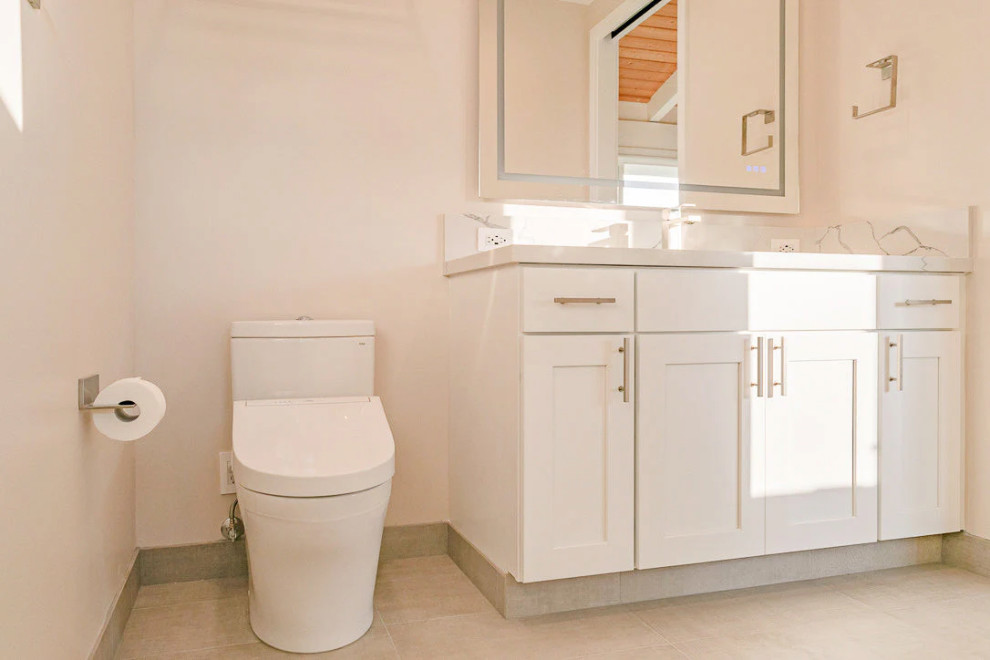
Conversely, a small bathroom remodel, despite its minimal square footage, is a microcosm of high-complexity construction. This tiny footprint requires the complete transformation of multiple integrated systems. It necessitates demolition, followed by specialized work from five or more trades: plumbing (new fixtures, piping), electrical (lighting, outlets, ventilation), HVAC (exhaust fan installation), carpentry (cabinetry, trim), and tiling/finishing (floors, shower surrounds, painting). Each of these systems must be carefully coordinated, sequentially installed, and perfectly integrated within a confined space. Also, this work is typically in an intimate area of the home, so tradespeople must protect the surfaces of the other rooms, hallways, doors, etc., that they have to go through in order to access the work, plus daily cleanup.
The cost drivers in the bathroom, therefore, are not the amount of floor space, but the density of high-value components and the intensive, skilled labor required to install them, plus the logistics involved to minimize impact to other areas of the residence and/or its occupants.
Items like custom tiling, glass shower enclosures, high-end fixtures, and waterproofing membranes all contribute significant, non-area-dependent costs. Furthermore, the labor hours per square foot skyrocket due to the precision needed for wet areas and the inherent inefficiency of working in cramped quarters. A plumber spends far more specialized, expensive time routing new copper or PEX lines to a new shower valve than a painter would covering a hallway wall.
In conclusion, relying solely on the price per square foot obscures the true economic realities of construction and remodeling. While useful for rough estimates on new builds or homogeneous tasks, this metric becomes a dangerous oversimplification when applied to highly detailed, system-intensive renovations. The higher cost of the small bathroom versus the large house repaint serves as a clear illustration: in construction, complexity, trade specialization, and material density are the actual currencies, proving that when it comes to pricing, the small can indeed be far more expensive than the large.